Home » Subsurface Vapor Monitoring System
Subsurface
Vapor
Monitoring
G-VMS™
Cell-resolved early leak detection for fuel storage facilities
G-VMS™ is an engineered, permanently installed external release-detection system for fuel storage tanks, tank farms, buried piping and secondary containment.
It detects volatile hydrocarbon vapors in the soil atmosphere of the vadose zone beneath the asset, identifying a release at the earliest stage of subsurface migration – before contamination reaches groundwater.
The G-VMS provides a detection layer independent of in-tank methods (ATG, SIR), with no shared failure modes.
Vadose-zone detection – ahead of groundwater impact
Cell-level localization – adjacent-cell confirmation
Dual-end surface access – verifiable, serviceable channels
No buried electronics – durable, passive network
G-VMS: Principle of Operation
The monitored footprint is divided into discrete subsurface sampling cells, each connected to the surface by a dedicated line. Under controlled vacuum, soil gas is extracted from each cell in sequence, with a purge step between channels, and analyzed at the surface. Every cell is an independent measurement channel.
Detection is referenced to a cell-specific, dynamically updated baseline. A deviation in one cell is cross-validated against its adjacent cells: a consistent spatial and temporal response confirms a genuine release, while an isolated, non-persistent deviation is flagged for review. This minimizes false alarms and locates the source at cell resolution.
The Subsurface Sampling Network
G-VMS Implementation
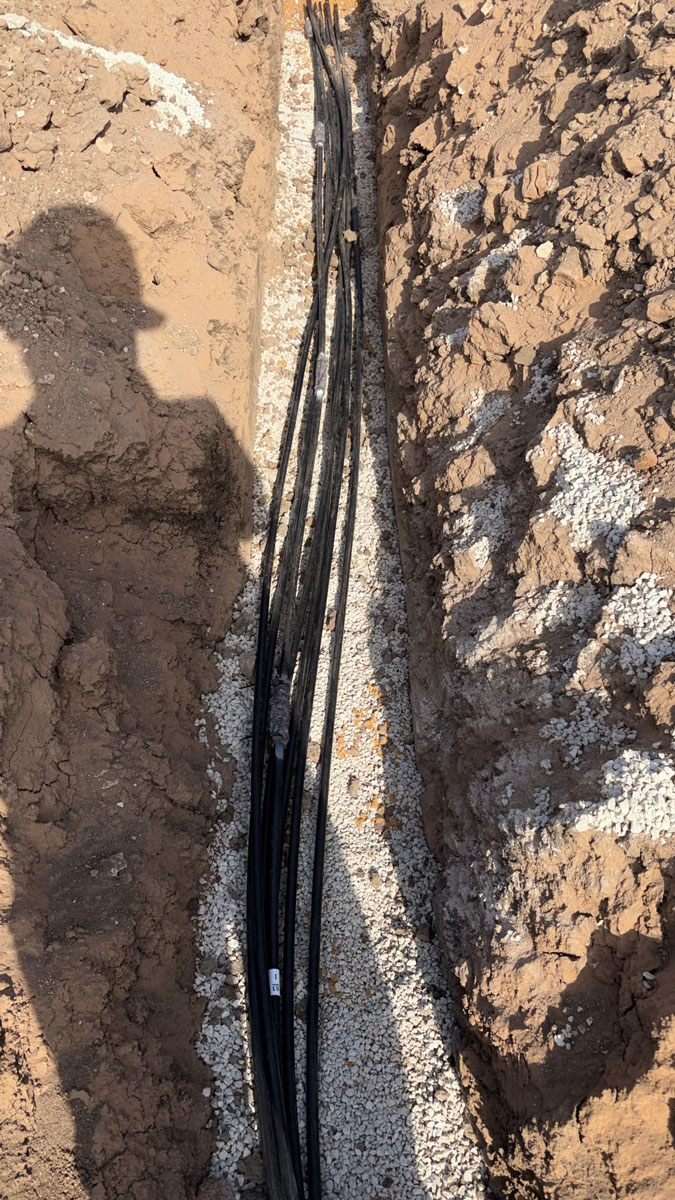
- Dual-end surface access: both ends of every sampling line terminate above grade, enabling end-to-end integrity and flow verification, independent confirmation sampling, purging and maintenance – without excavation
- High measurement reliability and continuous data-quality control (QA/QC) on every channel
- Durable, chemically resistant, corrosion-free piping, designed for the service life of the facility
- Passive network: no buried electronics or moving parts
- Cell layout, depth and spacing engineered per site, based on soil properties and asset layout; new-build or retrofit
Surface Equipment & Analysis
- Vacuum extraction unit with per-channel flow and pressure monitoring
- Multi-port valve manifold for sequential channel selection
- Analyzer-agnostic architecture: volatile hydrocarbon (VOC) analysis configured per stored product and project requirements
- Industrial controller and data logger with local buffering
- Solar-powered telemetry and logging unit, independent of facility power
Communication & Dedicated Sensoil Cloud
- Encrypted cellular IoT telemetry (LTE); remote diagnostics and configuration
- Dry-contact alarm outputs; SCADA/DCS integration
- Real-time web dashboard: site layout view, cell-level status, time series and baseline tracking
- Tiered alarm logic – advisory on baseline deviation, alarm on sustained, adjacent-cell-confirmed deviation
- SMS/e-mail notification; role-based access control
- Automated compliance reporting and full data audit trail
- Continuous self-diagnostics: vacuum, flow, analyzer, power and communication
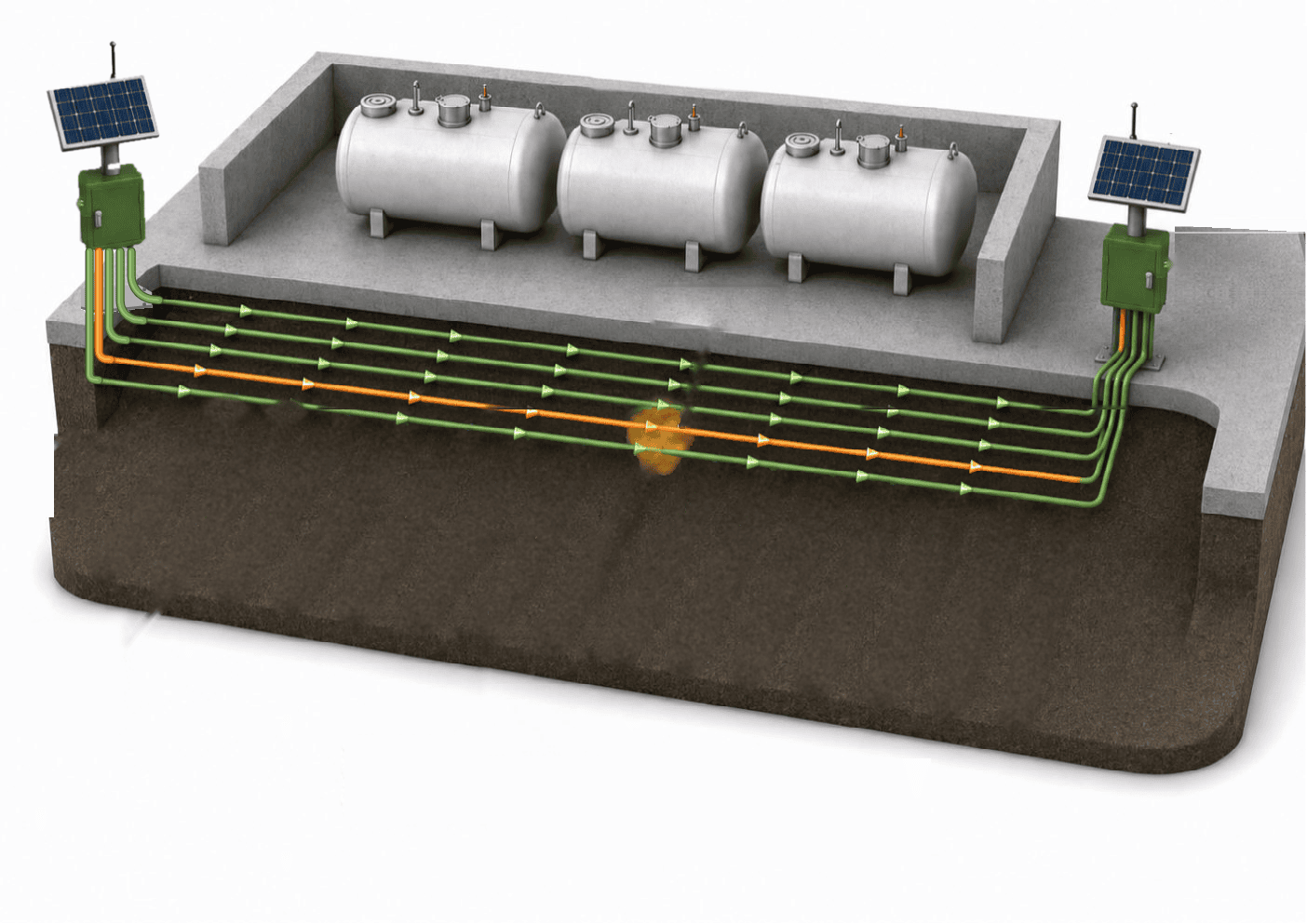
G-VMS Sensoil conceptual diagram
G-VMS Applications
- Power plant fuel storage (DFO)
- Refinery and terminal tank farms
- Aviation fuel facilities
- Industrial bulk storage
- Buried fuel piping
- Bunded containment areas
Photo Gallery